
EASO is pleased to speak with authors of EASO publications to better understand perspectives informing guidelines and position statements. In advance of World Obesity Day Europe on 4 March and International Women’s Day on May 8th 2026, we were delighted to speak with author Dr. Emilia Huvinen about the recently published EASO position statement on women with obesity across the reproductive life course.
Emilia, it’s great to connect and discuss this important publication with you.
Why was it important for EASO to develop a position statement specifically focused on women living with obesity across the reproductive life course, rather than addressing this within broader obesity guidance?
- Genders are not the same – although we are equal.
- Women are different in their body composition, hormones and response to interventions through lifestyle and medications
- Women also carry the next generation in themselves
- Obesity has an enormous impact on women’s life and on the next generation
- Often women’s health is only the focus for gynecologist
- And they are not trained in obesity
- Need for a higher-level view, more specialists involved
- Therefore, this position statement was needed to bring the importance of women’s health to the forefront also for other specialists and researchers
- Just imagine – helping women of reproductive age with obesity can potentially also have an impact on the next generation
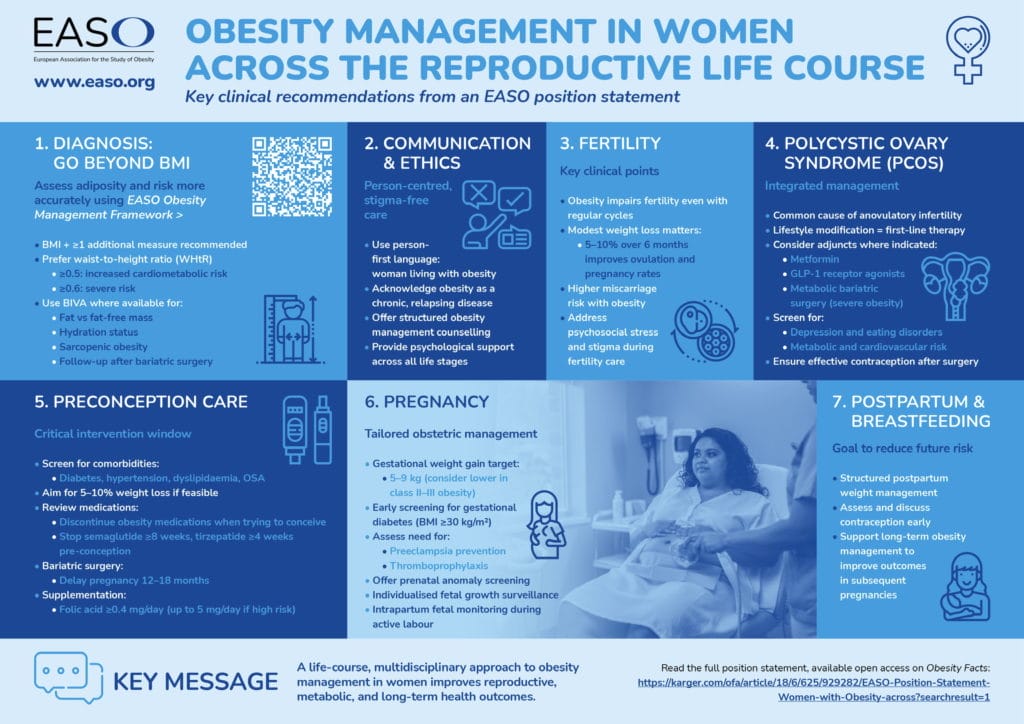
Emilia, the statement recommends moving beyond BMI to improve assessment and care, using the parameters outlined in the EASO Framework for Obesity Management. How could this shift change clinical conversations and decision-making for women?
- There is currently too much focus on numbers on the scale.
- That is what women do in their homes, but also what physicians are inclined to do in their practices
- However, we know that BMI is a great screening method on a population level but does not reflect individual health or disease and definitely not lifestyle.
- BMI is clinically not relevant and also not often good for the individuals living in larger bodies
- Moving away from the numbers on the scale enables us to talk about the true impact of obesity it has on an individual level – which is not about looks or norms of the society.
- It is the wellbeing of an individual and his/her future health and capabilities to pursue his/her dreams and goals
- It also helps us to talk more about lifestyle per se, and not only weight loss as numbers.
Psychological support and person-centered care are central themes in the position statement. What does meaningful, respectful care look like in practice for women at different reproductive stages?
- There is truly a need to see the individual stages of life each woman is going through.
- It is just not numbers on the scale, each person with overweight or obesity has their individual story and background.
- Meeting our patients where they are is the only way to go forward as a team – respecting their individual journey.
- We all have our own challenges and deserve help not given with a general measure but with an individual spoon – there where we need it
- Having a wish to conceive or becoming a mother relates to a fundamental desire in a woman’s life and raises specific concerns and fears, independent of their weight. Adding obesity to the picture, it becomes easily a very challenging picture with blame, fear, self-criticism and judgement from the society
- Pregnancy can add its own challenges to the picture, with e.g. symptoms related to morning sickness, premature contractions pregnancy complications, worry and physical challenges.
- All women deserve our support, independent of their background and weight
- Let’s ask what are the concerns, fears and wishes for each individual woman.
- What kind of support would they wish to receive from us. No judgement. No prejudice. No stereotypes.
Evidence suggests that relatively modest weight reduction can improve fertility outcomes. How can clinicians discuss this in a way that supports and empowers women without reinforcing stigma or creating unrealistic expectations?
- I believe honesty and authenticity are the key. If we come from true care for our patient, it will not reinforce stigma. I would warmly express my positive view how successful weight management can bring further improvements in fertility.
- Not highlighting the negative impact of obesity
- I also believe in asking about the individual fears of each patient and their wishes.
- It is also important to highlight the benefits of even small decreases in weight so that our patients don’t feel they need to achieve so called “normal weight” which can feel “miles away”.
If you could prioritize one change in research, clinical practice, or policy to improve care for women living with obesity across the generations and the reproductive life course, what would it be and why?
- I would love to implement easy access obesity care in contraceptive clinics around Europe.
- These future mothers deserve all our care and attention as they are also those carrying, nurturing, and taking care of our next generation
- Helping to treat their obesity may also have an impact on the next generation – what could be greater than that!
Dr. Emilia Huvinen is a gynecologist with a passion for obesity care. A co-author of the EASO position statement, she is a Specialist in Obstetrics and Gynecology and in November 2024, she was appointed associate professor. Her PhD focused on GDM and currently her research interest spans from long-term metabolic health of women with prior GDM to programming of obesity in the offspring.
Emilia is a board member of the Finnish Association for the Study of Obesity (FASO) and also a member of the international Diabetes in pregnancy study group (DPSG). Dr. Huvinen has taken part in many international collaborations, publications and presentations. Recently she contributed to the ICHOM (International Consortium for Health Outcomes Measurement) working group defining value-based goals for obesity care. She is one of the founders of the Nordic Obesity Network which aims to improve obesity care and education in Europe. In Finland she contributes actively to the public discussion around obesity for example though her book on obesity for general public, which will also be published in English spring 2026, and podcast on women’s health.
Read the full position statement open access: https://karger.com/ofa/article/18/6/625/929282/EASO-Position-Statement-Women-with-Obesity-across
 English
  French