Distinguishing Health Promotion from Obesity Prevention: Why Language Matters

Distinguishing Health Promotion from Obesity Prevention: Why Language Matters

Clear communication about obesity prevention is complicated by the way this term is used across different theoretical frameworks. From a public health perspective, complex systems approaches aim to reduce obesity prevalence at population level by improving environments, supporting healthier behaviours, and addressing multiple interacting drivers of health.

By reducing population exposure to risk factors and creating healthier living conditions for all, these approaches seek to shift population-level risk over time. In a chronic disease framework, however, “obesity prevention” refers more narrowly to preventing the biological onset of obesity in an individual. These are related but distinct aims, and clearer terminology helps ensure that health promotion, population risk reduction, and disease prevention are each recognised, evaluated, and funded appropriately.

For a long time, obesity was commonly viewed through a behavioural lens – and seen as the outcome of individual choices like eating too much or exercising too little. This perspective led to broad public health programmes, like promoting healthy eating or encouraging active living, being labeled as “obesity prevention”. These initiatives are essential for encouraging overall well-being across society and for supporting important non-scale outcomes such as metabolic health, blood pressure, fitness, sleep, and psychological wellbeing.

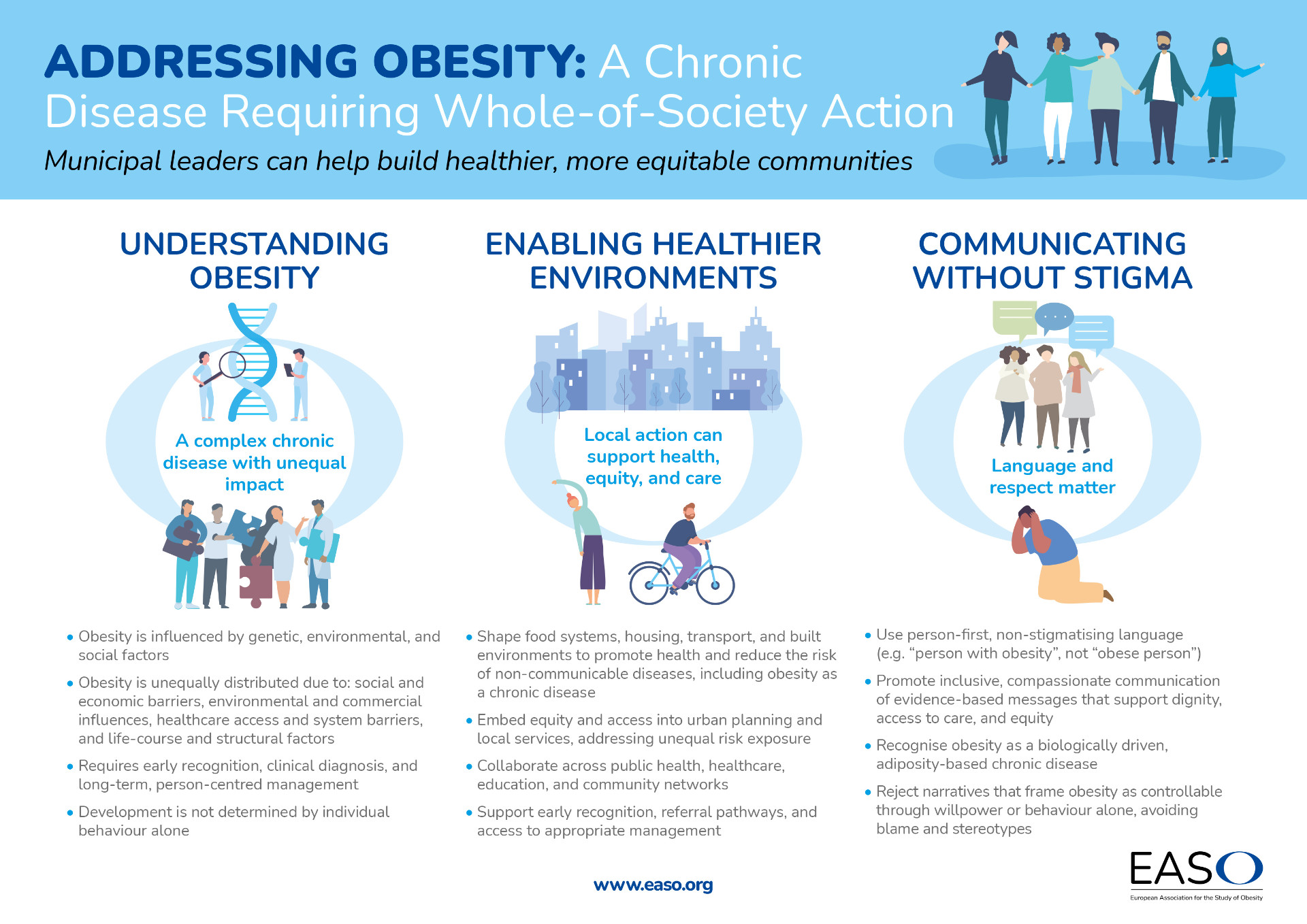
Infographic about addressing obesity, highlighting understanding obesity, enabling healthier environments, and communicating without stigma, with supporting points and illustrated icons.

Download the infographic in PDF format

However, advances in our understanding of the powerful biology of adipose tissue regulation and genetics underlying obesity have led to wide acknowledgement that obesity is an adiposity-based, chronic, relapsing disease. Its development is driven by biological, genetic, environmental, socio-economic, and psychological factors, alone and in combination, with the contribution of each differing between individuals and across populations. Genetic and environmental factors interact to regulate body weight – with heritability estimates ranging from 40% to 70%. This broader scientific and systems-based understanding has important implications for the way we think about prevention: healthier environments reduce exposure to risk, but they do not remove the variation in susceptibility that makes some individuals more likely to develop obesity than others. Even when environments are similar, two people may still have a different likelihood of developing obesity because of differences in the way that their personal biology, life-course exposures, and lived experiences interact. Public health programmes can improve important health behaviours, but the physiological systems regulating body weight are highly defended, meaning that these changes do not reliably prevent the biological onset of obesity.

This biopsychosocial and systems understanding encourages us to recognise the limitations of population-wide health promotion for preventing obesity in individuals. Public health measures shape exposure to risk, while biology and life-course factors shape susceptibility and influences how strongly a person responds to the same environment. The impact of new obesity management medications illustrates the strength of the physiological systems involved in body-weight regulation. More broadly, we have learned that for many people, especially those with a strong genetic predisposition, these biological forces – including changes in metabolism, hormones, inflammation, and adipose tissue function – are key drivers of obesity development and are unlikely to be substantially modified by traditional, broadly implemented health-promotion approaches.

This varied use of the term “obesity prevention” across the field can therefore create confusion and misunderstanding about what different approaches can realistically achieve, directly contributing to a weak evidence base that impedes effective action. Many programmes currently labelled “obesity prevention” are more accurately described as efforts to improve metabolic health, reduce risks associated with unhealthy diet or excess weight, or support weight management. These initiatives are highly valuable and necessary, but evidence that they prevent the biological onset of obesity – especially among people with higher genetic susceptibility – remains limited.

To move the field forward, we need more accurate language. In our EASO project we have created a Taxonomy of Obesity that provides a scientifically accurate, precise language that aligns with that used for other non-communicable diseases. Clarifying terminology from the outset can help align expectations, evaluation, and investment, and can support the development of targeted, multicomponent interventions that address both biological susceptibility and the social, environmental, and psychological drivers identified by chronic disease and complex-systems models.

Readers are invited to explore ‘Theme 3: Obesity Prevention’ of the EASO Obesity Taxonomy, which defines health promotion and obesity prevention, offering additional scope and context to support clear and consistent terminology across the field.

  1. Bowman-Busato, J., Schreurs, L., Halford, J. C. G., Yumuk, V., O’Malley, G., Woodward, E., … & Baker, J. L. (2025). Providing a common language for obesity: The European Association for the Study of Obesity obesity taxonomy. International Journal of Obesity, 49(2), 182–191. https://doi.org/10.1038/s41366-024-01565-9
  2. Busebee, B., Ghusn, W., Cifuentes, L., & Acosta, A. (2023). Obesity: A review of pathophysiology and classification. Mayo Clinic Proceedings, 98(12), 1842–1857.
  3. Busetto, L., Dicker, D., Frühbeck, G., Halford, J. C. G., Sbraccia, P., Yumuk, V., & Goossens, G. H. (2024). A new framework for the diagnosis, staging and management of obesity in adults. Nature Medicine, 30(9), 2395–2399. https://doi.org/10.1038/s41591-024-03095-3
  4. Celletti, F., Farrar, J., & De Regil, L. (2025). World Health Organization guideline on the use and indications of glucagon-like peptide-1 therapies for the treatment of obesity in adults. JAMA. https://doi.org/10.1001/jama.2025.24288
  5. Loos, R. J. F., & Yeo, G. S. H. (2022). The genetics of obesity: From discovery to biology. Nature Reviews Genetics, 23(2), 120–133. https://doi.org/10.1038/s41576-021-00414-z
  6. Manco, M. (2025). Obesity as chronic endocrine disease. Obesity and Endocrinology, 1(1), wjaf004. https://doi.org/10.1093/obendo/wjaf004
  7. Obesity Health Alliance. (2024). Treatment of overweight and obesity: Position statement & evidence review. https://obesityhealthalliance.org.uk/wp-content/uploads/2024/10/OHA_Treatment_2024.pdf
  8. Stronks, K., Rod, M. H., Rutter, H., & Rod, N. H. (2025). Towards a complex systems model of evidence for public health. BMJ Global Health, 10(10).
  9. Yeo, G. S. H. (2025). The importance of science communication surrounding weight-loss drugs. The Lancet Diabetes & Endocrinology, 13(12), 995–997. https://doi.org/10.1016/S2213-8587(25)00320-1

OTHER ARTICLES OF INTEREST